


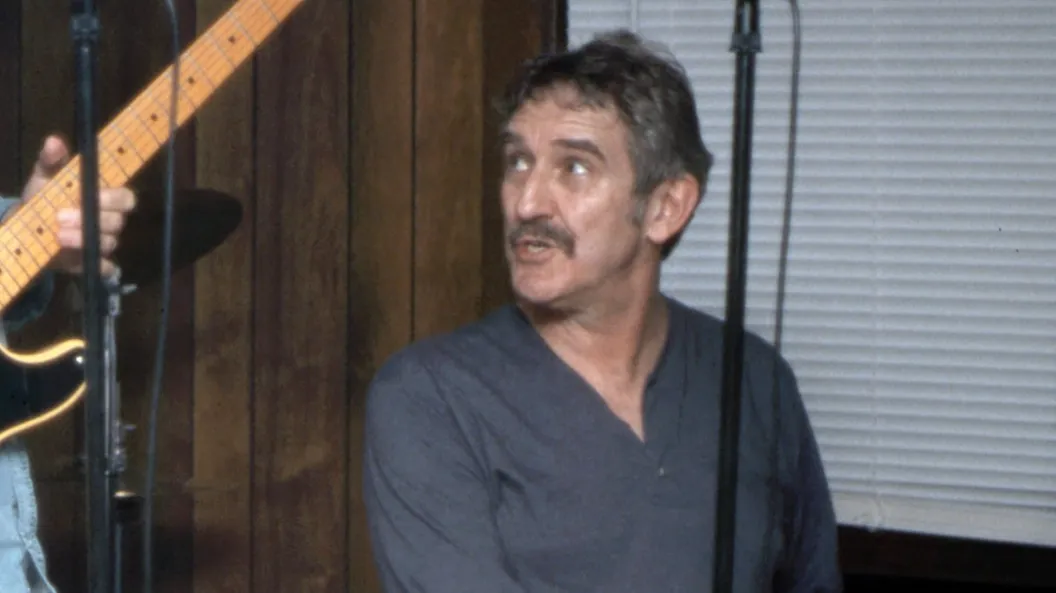
On this day (July 21) in 2015, Buddy Emmons died of a heart attack in Nashville, Tennessee, at the age of 78. He was one of the greatest steel guitar players in the history of country music. His innovative changes to the pedal steel added new levels of versatility and variety to the instrument. Those changes have since become the industry standard. Emmons played in the backing bands of multiple country legends. He also sat in on sessions with George Strait, Ernest Tubb, Roger Miller, Linda Ronstadt, and many others.
Emmons got his first lap steel guitar when he was 11 years old. Initially, he took lessons in traditional Hawaiian music. Then, he started learning to play his favorite country songs. By his mid-teens, he was playing a triple-neck Fender Stringmaster in bands around the South Bend, Indiana area.
His career took off when he was just 16 years old. He dropped out of school and moved to Calumet City, Illinois. There, he played with Stony Calhoun before relocating once again. This time, he landed in Detroit backing Casey Clark. He also bought a Bigsby pedal steel while in Motor City. Before long, he caught the attention of Little Jimmy Dickens, one of the Grand Ole Opry’s biggest stars. Emmons then moved to Nashville to back Dickens.
While working with Dickens, Emmons recorded several instrumentals. Two of those–“Raising the Dickens” and “Buddie’s Boogie”–were originals that would go on to be pedal steel standards. In 1956, a year after Emmons came to Music City, Dickens dissolved his backing band. However, Emmons didn’t have to worry about being out of work.
Buddy Emmons Gets Comfortable in Nashville
After Little Jimmy Dickens dissolved his band, Buddy Emmons signed on with Ernest Tubb’s Texas Troubadours. Later, he became a member of Ray Price’s Cherokee Cowboys. During this period, Price employed several future legends. His ever-changing lineup included Roger Miller, Johnny Paycheck, and Willie Nelson, among others.
Emmons also took on session work, playing with some of Nashville’s A-list. In fact, one of his first sessions was on Faron Young’s hit “Sweet Dreams.” Over the years, he played on sessions for George Strait, Ray Charles, John Hartford, Linda Ronstadt, Gram Parsons, and many others.
A Musical Innovator
The pedal steel guitar was not a simple instrument to start with. The strings and metal tone bar are only a fraction of the equation. The real magic lies in the pedals and knee levers under the instrument. Steve Fishell, who played pedal steel for Emmylou Harris, described the instrument to NPR. “It’s like a Rubik’s Cube of an instrument that’s not unlike driving a stick-shift truck through landmines,” he explained.
[RELATED: 3 of the Greatest Pedal Steel Guitar Solos in Country Music History]
Buddy Emmons made things a little more complicated. He added two more strings. Then, he split one of the pedals in half. He also developed a mechanism that could bend the strings and return them to their original pitch without throwing the instrument out of tune.
Emmons mastered his creation, in part, by practicing in the dark. “My senses were a little keener,” he said. “It allowed me to hear what I was doing in a different way. It allowed me to feel what I was doing in a different way. I just liked the feeling of what went on in my head while the lights were out,” he explained.
Today, pedal steel is one of the signature elements of good country music. Without the contributions and innovations of Buddy Emmons, it wouldn’t be the same.
Featured Image by Robert Alexander/Archive Photos/Getty Images
The post 11 Years Ago Today, We Lost the Steel Guitar Wizard Who Forever Changed the Way Country Music Sounds appeared first on American Songwriter.
Author: Clayton Edwards
« Remember Vin Diesel’s Lost Hip-Hop Collaboration With This Avant-Garde Music Legend From 1986?