


The 1980s were a big decade for music. Hair metal bands were packing stadiums, new wave and punk were sweeping the country, and pop was larger than life thanks to MTV. The sound of music was changing across all genres in the 1980s, and behind it were a few iconic guitar amps. Let’s break it down and put a name to some of the decade’s most iconic sounds.
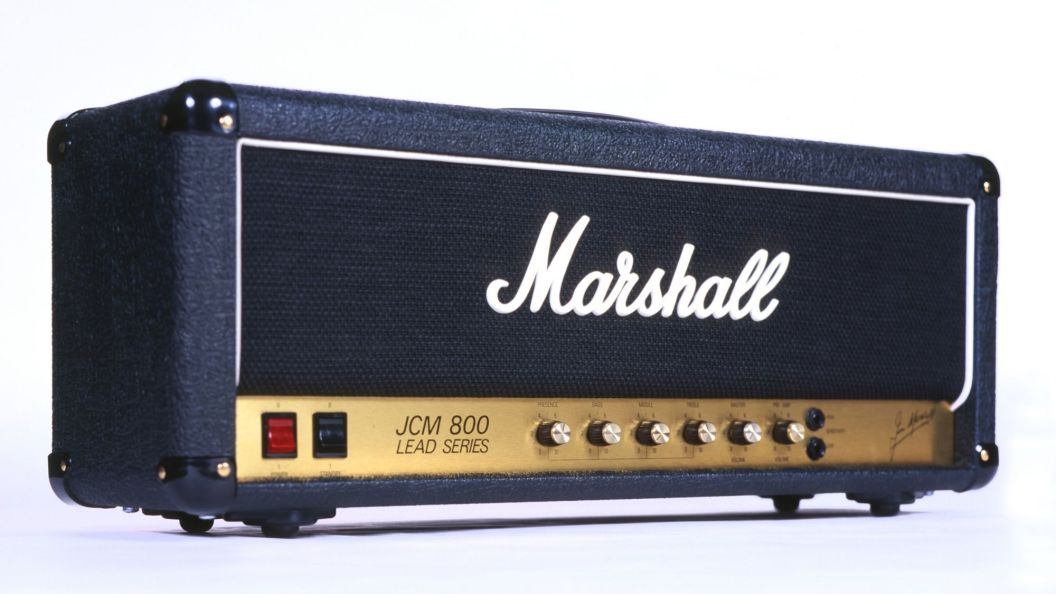
Marshall JCM 800
Debuting in 1981, the Marshall JCM 800 became the defining sound of 80s rock. This amplifier was iconic due to its master volume control, which Marshall introduced in 1975, and its more aggressive sound. This allowed the JCM 800 to go beyond the capabilities of its predecessors. In addition to the heavier sound, a big key to the amp’s success was its affordability.
Before 1981, Marshall was working with the distribution company Rose-Morris to export amplifiers to the United States. As a result, the company added a 55% markup. This added cost priced out many aspiring rockers from getting their hands on Marshall’s products. Dissolving their relationship in 1981, the removal of the 55% markup and the flexibility of the JCM 800 placed this amplifier in the hands of the young musicians who would shape the sound of the decade.
Looking at photos and music videos from the 80s, you will almost always see a JCM800 make an appearance. These amps could be heard and seen everywhere. From hair metal bands blowing the roof off the Whisky A-Go-Go to punk rockers thrashing away in CBGB, this iconic amplifier was front and center.
Roland JC-120 Jazz Chorus
The Roland JC-120 Jazz Chorus was another icon shaping the sound of music in the 1980s. Originating in 1975, the JC-120 was a solid-state amplifier designed by the Japanese corporation Roland. Its 120 watts of power and 2×12 speaker configuration gave it a large sound that was tight and clean. However, what made this amp an icon was the onboard chorus.
The chorus circuit of the JC-120 was a stereo effect, bouncing between the amp’s two 12” speakers. This gave the amplifier a rich three-dimensional sound that transcended genres and landed it a spot on some of the decade’s most iconic recordings.
Examples of the JC-120 being used in the 80s are songs like “Just Like Heaven” by The Cure, “Time After Time” by Cyndi Lauper, and “Every Breath You Take” by The Police.
Mesa/Boogie Mark Series
Another favorite among the hard rock and metal players of the decade was the Mesa/Boogie Mark Series. Starting back in 1972, the Mark Series started as modified Fender Princeton amps. Taking the Princeton’s 15-watt 1×10 combo platform, the Mesa increased the power and speaker size while adding a cascaded hi-gain preamp. This resulted in a compact but powerful amplifier that delivered more gain and distortion than any other at the time. With demand growing and music changing, so did the Mark Series.
There were many variants in the Mark Series. The most important for the 80s were the Mark II and Mark III models. The Mark II made its debut in 1978. It was the first mass-produced amplifier on the market to offer channel switching. This allowed players the ability to switch between a clean channel and a more overdriven lead channel; this was done via a supplied footswitch. The Mark III arrived in 1985; it added a third gain channel, rhythm crunch. This third channel acted as a bridge between the Mark II’s clean and lead channels, giving players even more flexibility. Throughout this series, options like onboard graphic EQ, push-pull knobs, and effects loops increased the amp’s appeal.
Iconic users of the Mesa/Boogie Mark series amps were players like John Sykes of Whitesnake, as well as Kirk Hammett and James Hetfield of Metallica. Sykes used a Mark III on Whitesnake 1987. It would be immortalized on iconic tracks like “Here I Go Again” and “Still of the Night”. Hammett and Hetfield would use them in Metallica for both 1985’s Master Of Puppets and 1988’s …And Justice For All.
Rockman X100
Although it’s not technically an amplifier, the Rockman X100 is responsible for some of the decade’s most iconic sounds. Designed by Tom Scholz of the band Boston, the X100 was originally designed to be a practice tool. This compact device came with a pair of headphones and even had a belt clip, allowing the player to connect it to their belt.
Although it was small in size, it was loaded with great features like a compressor, echo, chorus, and four different modes ranging from clean to distortion. Sounding great through headphones, what made it an icon was its line-out option. This allowed the X100 to be plugged directly into studio consoles where it could be recorded. This feature placed it on some giant records in the 80s, such as ZZ Top’s Eliminator, Joe Satriani’s Surfing With The Alien, and, of course, Def Leppard’s Hysteria.
Closing Thoughts
Were other amps used to create some of the 1980s’ most defining tracks? Of course! But when it comes to those that shaped the sound the most, I firmly believe these four made up its core. Still influencing and pushing music forward, the impact these amplifiers made in the 80s was merely the beginning.
Photo by Richard Ecclestone/Redferns
The post 4 Legendary Guitar Amps That Shaped the Sound of the 1980s appeared first on American Songwriter.
Author: Sam Blalock
« 3 Decade-Defining Songs From the 1960s That Vietnam War Veterans Still Remember
Megan Moroney Says ‘No Girl Best Friend’ If You Want To Date Her »