


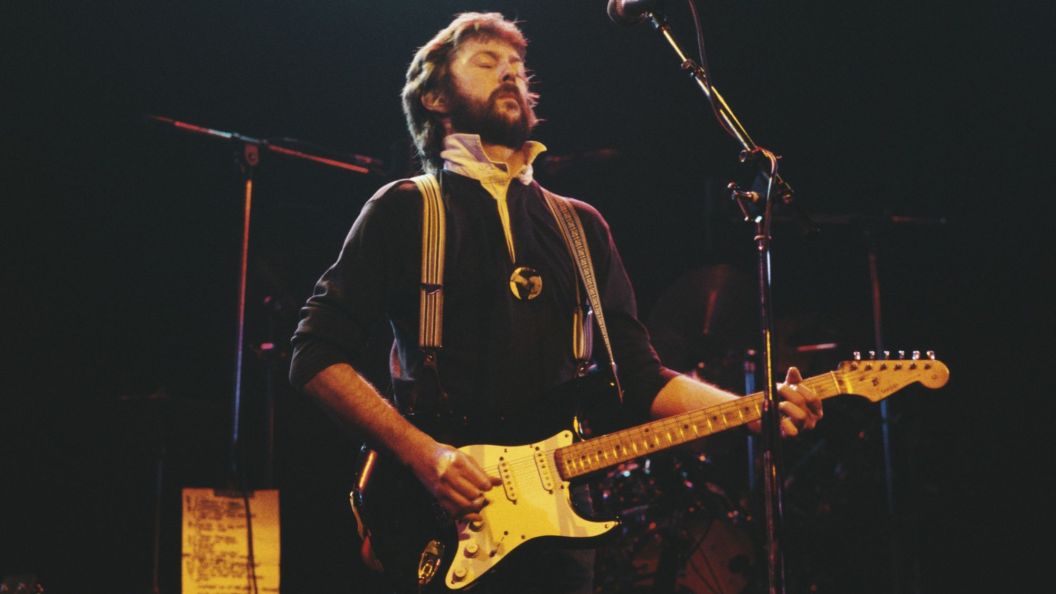
We’ve covered Eric Clapton’s 60s guitar tones and how to get them; now it’s time to cover the 70s. Having found success with The Yardbirds, John Mayall and The Blues Breakers, Cream, and Blind Faith, Clapton was looking for a change. He grew tired of the heavy rock sound and long solos that made him an icon. He wanted to write more song-driven material and chase a less aggressive sound.
Influenced by the rootsy sound of groups like The Band, he began this transition touring with Delaney & Bonnie. By the end of the 70s, he had formed Derek And The Dominos (a band that released just one album, Layla And Other Assorted Love Songs) and released three solo albums. The decade when Clapton formed the sound we know him for today- let’s dive deep and learn how to replicate it.
The Guitars: 1950s Fender Stratocasters (Brownie & Blackie)
Clapton was known for primarily playing Gibson guitars in the 60s. However, if we’re chasing his 70s sound, we will need a Fender, specifically a Stratocaster. The transition from Gibson to Fender began when he was playing with Blind Faith. Playing a Telecaster with a Stratocaster neck at their famous Hyde Park concert, he would move to a Stratocaster by the time he released his first solo album in 1970.
Tired of his “rock god” status, Clapton began chasing a rootsier sound. The thinner and chimier sound of the Stratocaster was the perfect vehicle. In the 70s, he was known for playing two 1950s-era Stratocasters, Brownie & Blackie. Clapton played Brownie on his first solo album and with Derek and the Dominos. From 461 Ocean Boulevard and onward, Blackie became his main stage guitar. Brownie was an all-stock 1956 sunburst Stratocaster, while Blackie was a guitar made up of three separate Stratocasters from the same era.
To get the sound of his Stratocasters from this period, we want 50s specs, specifically a maple neck. Three fantastic options are the Squier Classic Vibe 50s, the Vintera III late 50s, and American Vintage II 1957 Stratocasters. These instruments, at three price points, will give you the look and the sound. The higher you go in the price range, the more accurate it will be.
Amplifiers
Unlike his guitars in this era, Eric Clapton used a few different amplifiers. Transitioning from his large Marshall rigs of the 60s, Clapton wanted something that better complemented his new musical direction. Here are a few of the amplifiers Clapton used throughout the 70s.
Large Fender Amps (Dual Showmans, Twin Reverbs)
Starting with Delaney & Bonnie, Clapton was beginning his transition from Marshall. During the early parts of the decade, his live rig typically featured a large Fender amp. Amplifiers like Twin Reverbs and Dual Showman heads with large Marshall or Fender cabinets are seen in photos and videos from this period. To replicate the sound of these amps, a ‘65 Reissue Deluxe Reverb or Twin Reverb from Fender will nail the sound. If you want something lighter and more versatile, the Fender Tone Master series Deluxe and Twin provide the sound and look with more flexibility.
Fender Champ
Designed by Fender as a practice amp, the Champ was used often by Clapton in the studio. Its compact size and low wattage made it the perfect amp for recording; this is the sound heard all over the Derek And The Dominos album Layla And Other Assorted Love Songs. To achieve this sound, there are two fantastic options. The Fender Pro Junior and the Fender 57’ Custom Champ.
The Fender Pro Junior is the more affordable option of the two. This compact amp features 15 watts of power, a simple volume and tone control layout, and a 10-inch Jensen speaker. It has more wattage than a Fender Champ, but it has that small, gritty sound when turned up. The 57’ Custom Champ is the other option and the most accurate. It’s only 5 watts, features a single knob, and its compact cabinet houses an 8-inch speaker. If you crank this option up with a Stratocaster plugged in, you’ll nail the sound.
Musicman HD-130 Heads
By the mid-70s, Eric Clapton moved away from classic Fender amps and moved to Musicman. He was known during this time to use their HD-130 heads and matching 2×12 or 4×12 cabinets. The amplifiers were unique because of their hybrid design, featuring both solid-state and tube technology within. Musicman amps had solid-state preamps and tube power amps. They sounded similar to the Fenders he loved but had a master volume option that made them more flexible. This allowed him to turn up the amplifier to achieve his desired level of distortion and then drop the overall volume back down as needed.
Unfortunately, Musicman no longer makes amplifiers. To purchase one, you will have to buy a genuine vintage example on the used market. Fortunately, compared to other vintage amps on the market, they are still quite affordable and are quite common to source. If you want something new, go with the large Fender amps listed previously.
Effects
During this time period, Clapton was using a couple of effects: a wah pedal and a Leslie rotary speaker. A holdover from the 60s, Clapton used the wah pedal to a similar effect and is more often heard using it live. The Leslie Rotary speaker was used more often live as well; however, it appeared on a few studio recordings. The most famous recording from this decade featuring it is “Cocaine”.
For the wah pedal, a classic GCB95 Crybaby wah from Dunlop or a V847 from VOX will do the trick perfectly. For the Leslie, there are a few options. The JHS 3 Series Rotary, BOSS RT-2, and Strymon Lex Rotary are all fantastic. They’re compact, versatile, and nail the sound without having to haul a large cabinet around.
Closing Thoughts
Rejecting his “rock god” label and moving to something more song-oriented and laid back, the 70s were the decade Eric Clapton began to find his sound. From his transition with Delaney & Bonnie to his soaring solo career, Clapton successfully managed to shed the label and come out the other side. Going into the 80s, the Eric Clapton we know now had arrived.
(Photo by Michael Putland/Getty Images)
The post Tone-Torial: How To Sound Like Eric Clapton in the 1970s appeared first on American Songwriter.
Author: Sam Blalock
« Remembering When a Top Songwriter Used a Baseball Icon as a Symbol for a No. 1 Hit Single in 1968