


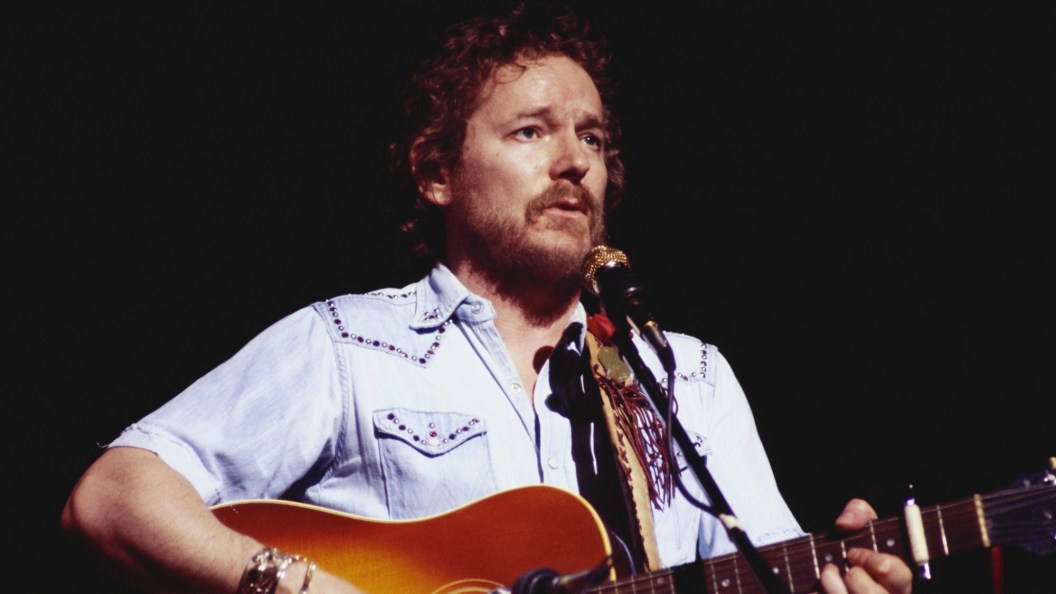
On this day (November 17) in 1938, Gordon Lightfoot was born in Orillia, Ontario, Canada. He was a singer/songwriter who found international chart success and critical acclaim. Additionally, Marty Robbins, Bob Dylan, Elvis Presley, Peter, Paul, & Mary, and many others covered his songs. While he notched several chart hits, his most enduring song is “The Wreck of the Edmund Fitzgerald.”
Lightfoot grew up singing in his church’s choir. Later, he won a young-singer competition that led to his first appearance at Massey Hall in Toronto, where he would perform dozens of times throughout his career. He learned guitar and began performing regularly as a teen. Then, in the late 1950s, he moved to Los Angeles, where he sang demos and wrote and recorded jingles.
Lightfoot returned to Canada in 1960 and soon became part of the growing folk movement in Toronto. According to the Canadian Songwriters Hall of Fame, he built his repertoire while playing in coffee shops and clubs in the Yorkville area.
He spent three years honing his craft and gaining a following before moving to the United Kingdom for a year. There, he hosted Country and Western on the BBC. Then, he returned to Canada. Soon, other artists started recording his songs. Ian & Sylvia recorded “Early Morning Rain” and “For Lovin’ Me.” Those songs were later recorded by Bob Dylan, Elvis Presley, the Grateful Dead, and George Hamilton IV. Marty Robbins had a major country hit with Lightfoot’s “Ribbon of Darkness.”
Gordon Lightfoot Finds Mainstream Success
Gordon Lightfoot signed with United Artists and released his debut album, Lightfoot!, in 1966. It contained “I’m Not Sayin’,” which became his first national hit in Canada. It reached No. 12 on the pop chart and No. 2 on the country chart. Non-album singles “Spin Spin” and “Just Like Tom Thumb’s Blues” put him in the top 10.
He began seeing international success in 1970. “If You Could Read My Mind,” a No. 1 hit in Canada, went to No. 5 on the Hot 100. It also reached the top 40 in the United Kingdom and Australia.
Lightfoot had a major hit in 1974 with “Sundown.” It went to No. 1 on multiple charts, including the Hot 100 and Adult Contemporary surveys in the United States. Two years later, he released his signature song, “The Wreck of the Edmund Fitzgerald.” While it was far from his final hit, it was his most enduring.
Keeping the Memory of a Tragedy Alive
The Edmund Fitzgerald sank on Lake Superior on November 10, 1975. All 29 members of the ship’s crew died in the frigid water. According to Songfacts, Gordon Lightfoot first read about the tragedy in an issue of Newsweek. However, the article only scratched the surface. He needed to know more.
The research, he said, “was quite an undertaking.” He gathered newspapers from the area until he could build a cohesive timeline of the wreck. Then, he wrote the lyrics commemorating the wreck to the melody of an Irish dirge he learned as a child.
[RELATED: Gordon Lightfoot’s First Big US Hit Dealt Intensely with His Failing Marriage]
He released the song in August 1976 as a single from Summertime Dream, and it became an international hit.
Every year, the Great Lakes Maritime Academy holds a memorial service for the sailors who died on the Edmund Fitzgerald. They ring a ceremonial bell 29 times to commemorate those lost to the cold waters. After Lightfoot died in 2023, they rang the bell 31 times. “Twenty-nine for the lives lost that day back in 1975 on Lake Superior, once for all the lives lost at sea, and once for Gordon Lightfoot, who wrote the ballad of the ship’s sinking.”
The song has since been covered by a variety of artists, including Tony Rice, Billy Strings, Headstones, the Longest Johns, and the Rheostatics, among others.
Featured Image by Michael Ochs Archives/Getty Images
The post Born 88 Years Ago Today in Canada, the Songwriter Who Immortalized a Maritime Tragedy and Had His Songs Recorded by Bob Dylan, Marty Robbins, and the Grateful Dead appeared first on American Songwriter.
Go To Source | Author: Clayton Edwards
« 3 Top 40 Hits From 1990 That Every 90s Kid Still Knows by Heart Today