


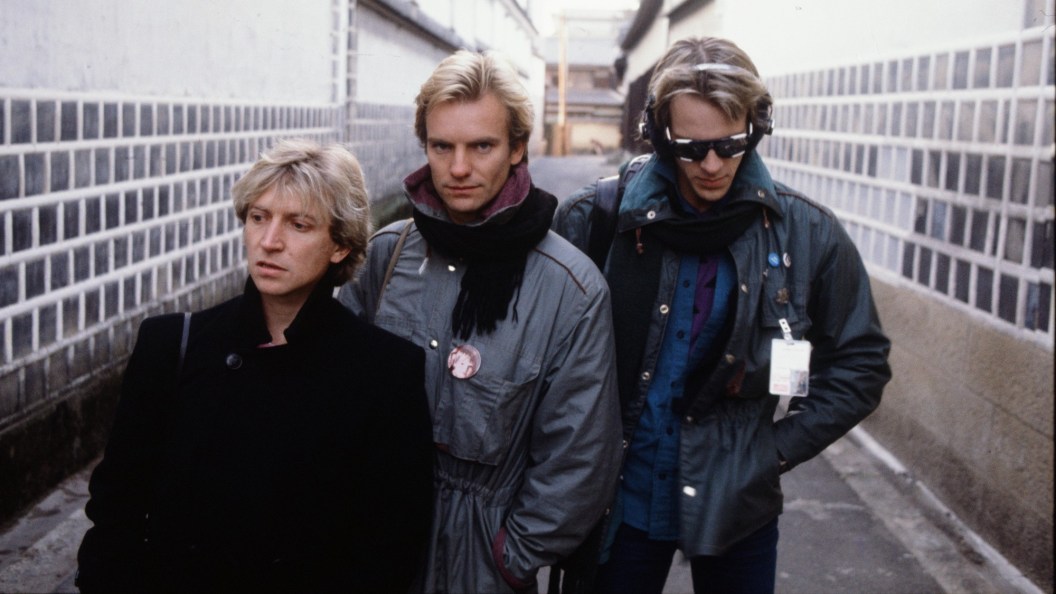
Growing pains are a very real issue with top bands. Major changes generally accompany major success. And it’s hard to keep every member of the band moving at the same pace towards a common goal. On the surface, “Ghost In The Machine” appeared to be just another in the long line of hits produced by The Police during their extended peak period. The smoothness of the song helped to hide some of the internal bumpiness enveloping the group who made it.
‘Machine’ Learning
The Police entered the making of their 1981 album Ghost In The Machine on a dizzying high. Their previous LP, Zenyatta Mondatta, featured their first two US Top 10 hits. That added to the previous success that they’d achieved in their native Great Britain.
The hectic pace they were keeping was starting to wear on the trio, however. Always an uneasy mixture of personalities, the three men also started to rub each other the wrong way. Broadly put, guitarist Andy Summers and drummer Stewart Copeland were beginning to chafe at bassist and singer Sting’s increasing dominance over the band’s artistic direction.
When The Police settled in to make Ghost In The Machine, Copeland and Summers had to cope with the fact that Sting came in with fleshed-out demos of several songs. That flew in the face of their previous method of working tracks from the ground up in the studio. One of the new songs that came almost fully formed was “Spirits In The Material World”.
Free “Spirits”
Sting wrote “Spirits In The Material World” on a synthesizer, a somewhat new endeavor for him. The lyrics were inspired by the work of author Arthur Koestler, whose book The Ghost In The Machine lent the album its title.
Recording the song caused quite a bit of friction. Summers had to battle with Sting to get his guitar into the mix. Sting eventually relented to a degree. But even when it does appear in the song, the guitar takes a secondary role to the synths.
Nonetheless, the song added to the band’s rising success, hitting No. 11 in 1981 as the second single from the album. But considering the behind-the-scenes drama while making it, you can understand why the band made it through just one more album (Synchronicity in 1983) before calling it quits.
Behind the Lyrics of “Spirits In The Material World”
“Spirits In The Material World” speaks eloquently of the struggle for humanity to rise above the machinations of societal institutions. “There is no political solution,” Sting robotically drones in the opening verse. “To our bloody evolution.”
In the second verse, he warns about “so-called leaders.” Their words are nothing but “the rhetoric of failure,” he insists. The final verse finds him lamenting about people trying to purchase their way to transcendence. “If it’s something we can’t buy,” he ponders. “There must be another way.”
“Spirits In The Material World” is an effortlessly haunting track that displays the unique chemistry of this trio. Unfortunately, the personal connections between the three men were fraying beyond repair even as they created this captivating song.
(Photo by Koh Hasebe/Shinko Music/Getty Images)
The post This Song by The Police Exposed the Growing Fissures Within the Band appeared first on American Songwriter.
Go To Source | Author: Jim Beviglia
3 Bruce Springsteen Songs That Showcase a Different Side of the Rock Icon »