


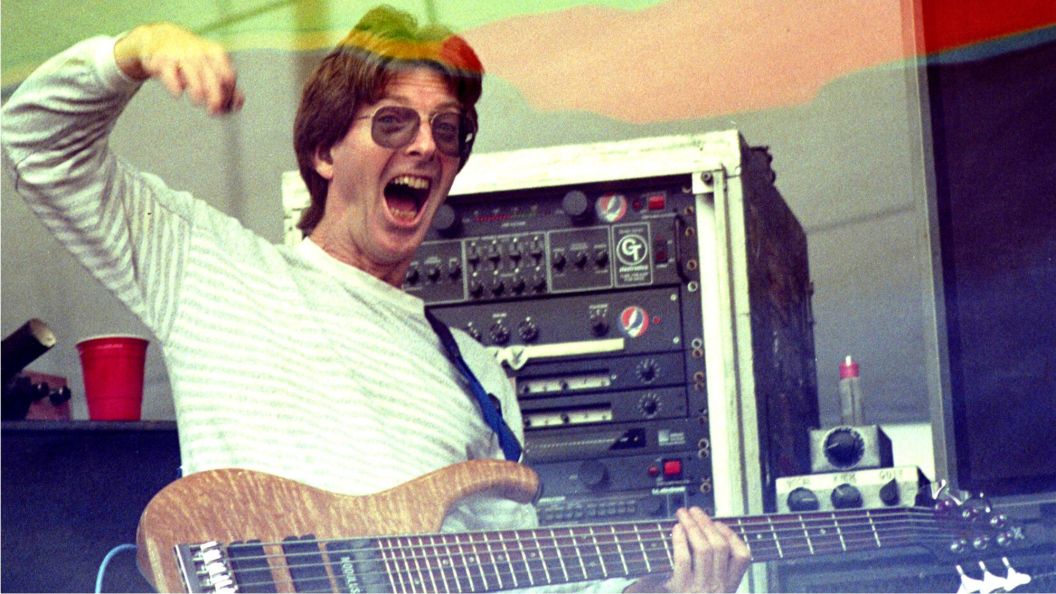
On this day (October 25) in 2024, founding Grateful Dead bassist Phil Lesh died at age 84. A member of the iconic jam band for its entire three-decade run, Lesh brought the bass to the forefront of rock music, perfectly complementing frontman Jerry Garcia’s groundbreaking guitar work.
The band’s surviving members – Bob Weir (who later died in January 2026), Mickey Hart, and Bill Kreutzmann – eloquently summed up Lesh’s importance to both the Grateful Dead and rock music as a whole in a statement issued after his death.
“Today we lost a brother… Phil Lesh was irreplaceable,” it read. “In one note from the Phil Zone, you could hear and feel the world being born. His bass flowed like a river would flow. It went where the muse took it. He was an explorer of inner and outer space who just happened to play bass. He was a circumnavigator of formerly unknown musical worlds. And more.”
Today, we’re honoring Phil Lesh’s remarkable life and legacy on the second anniversary of his passing.
Early Life and Musical Beginnings
An only child, Philip Chapman Lesh was born on March 15, 1940, in Berkeley, California. At age eight, he took up the violin at his father’s encouragement, later switching to trumpet during his time at Berkeley High School.
“I was awakened to the power of music early in life through the magic of radio broadcasts and by listening to my father play, from memory, his favorite tunes on the piano,” Lesh wrote in his 2005 autobiography, “Searching for the Sound: My Life With the Grateful Dead.”
Lesh’s early influences were about as far from rock and roll as you can get. He gravitated toward free jazz, classical music and the avant-garde. By his mid-teens, he was more interested in composing than performing, drawing inspiration from Beethoven and Charles Ives.
After high school, Lesh attended the College of San Mateo, where he wrote arrangements for the school’s big band and played trumpet. In 1961, he transferred to the University of California, Berkeley. There, he befriended future Grateful Dead keyboardist Tom Constanten. The following year, Lesh studied under the Italian modernist composer Luciano Berio during a graduate-level course at Mills College in Oakland.
Phil Lesh Had Zero Bass Experience
Phil Lesh’s path first crossed with Grateful Dead frontman Jerry Garcia’s while the former was volunteering as a recording engineer for a local radio station. The two bonded despite their divergent musical interests — Garcia was partial to bluegrass — and in 1965, he invited Lesh to play bass with his new band, the Warlocks.
There was just one minor problem — Lesh had never played bass before. He had expressed his interest in learning electric bass to Garcia at a recent party, and now the banjo player was ready to take him up on that offer.
“Garcia takes me aside and puts a beer in my hand and says, ‘Listen man, you’re gonna play bass in my band,’” Lesh recalled in a September 1974 interview with ZigZag magazine. “‘But I…er…who me? Well Jesus, that might be possible.’”
Embracing the challenge, he spent the two weeks preceding the band’s first gig familiarizing himself with the bass guitar.
“Yeah, I didn’t play too good man,” he admitted. “It was a real wooden sound, real stiff.”
Changing the Face of Rock and Roll
No bassist has ever done it quite like Phil Lesh. His inexperience allowed him to reimagine the instrument’s role entirely, drawing inspiration from Bach and the jazz bassist Charles Mingus.
“Phil was one of the weirdest bass players in the history of rock… Rather than playing typical rock basslines, Phil played continual streams of improvised counterpoint, with no repetitive patterns at all,” wrote New York University music professor Ethan Hein.
Lesh co-wrote almost every track on the Grateful Dead’s 1968 sophomore album Anthem of the Sun. He also composed the melody for “Box of Rain”, the opening track from the band’s 1970 album American Beauty.
According to Robert Hunter, “Phil Lesh wanted a song to sing to his dying father and had composed a piece complete with every vocal nuance but the words. If ever a lyric ‘wrote itself,’ this did—as fast as the pen would pull.”
Lesh’s recollection of how the song came about is slightly different.
“Actually, I merely mentioned casually that I’d be working out the vocals as I drove to visit [my father],” Lesh stated in his autobiography, Searching for the Sound. “One way or another, that must have been a catalyst for his imagination—a day later, he presented me with some of the most moving and heartfelt lyrics I’ve ever had the good fortune to sing.”
[RELATED: How Phil Lesh Reimagined the Electric Bass]
After the band dissolved following Garcia’s 1995 death, Lesh formed the Other Ones along with Bob Weir and Mickey Hart in 1998. Following their 2002 breakup, he formed the dead.
From 1999 to 2006, Lesh released three albums credited to Phil Lesh and Friends
Featured image by Tim Mosenfelder/Getty Images
The post 2 Years Ago Today, We Lost the Grateful Dead Legend Who Turned His Father’s Final Days Into One of the Band’s Most Beloved Songs appeared first on American Songwriter.
Author: Erinn Callahan
« 4 Pop Lyrics From the 70s That Sound Like Brutally Honest Confessions
Every Vietnam War Veteran Alive Remembers These 3 Must-Hear Anthems From 1970 »