


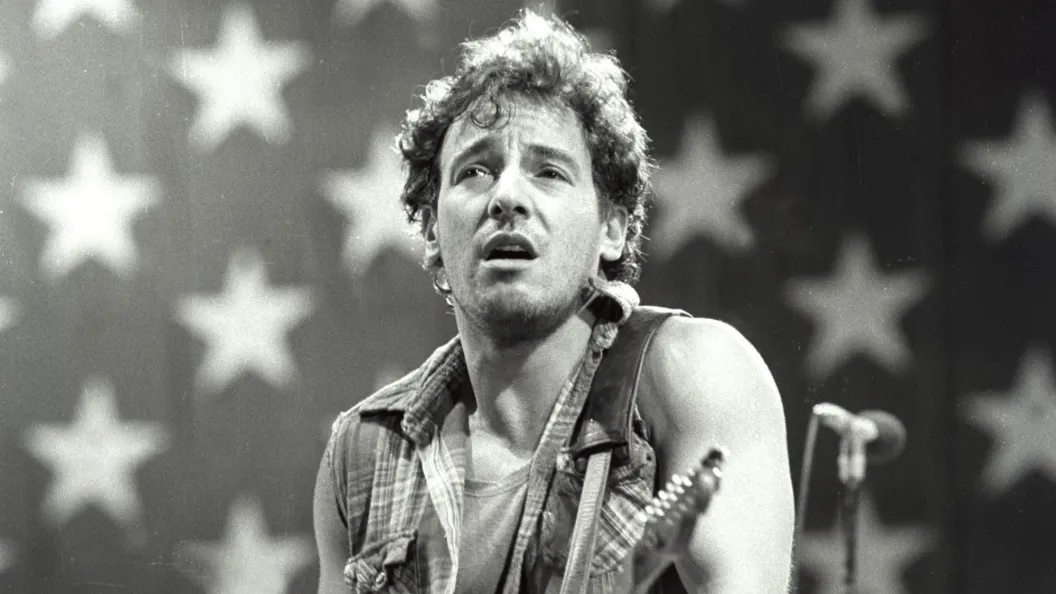
Hit singles are a funny thing. Many highly-respected artists released wonderful music for years in the 60s, 70s, and 80s and never got much attention from the charts. Timing and styles often dictated whether they ever broke through. For a while, it looked like Bruce Springsteen might end up one of those artists perpetually stymied in their attempts to win over pop music fans. And then, in 1984, Springsteen released an album that simply couldn’t stop spitting out hit songs.
Long Road to the Pop Top
Bruce Springsteen stood out throughout the 70s as the rare rock artist who gained superstardom without the benefit of massive hit singles. His first four albums produced two Top 40 hits (“Born To Run” and “Prove It All Night”), neither of which made it into the Top 20.
Springsteen seemed ready to bust down the pop music door when “Hungry Heart”, from The River, soared into the Top 5 in 1980. But the follow-up single “Fade Away” was a relative letdown at No. 20.
In 1982, Springsteen released the stark, acoustic Nebraska album. The LP blew critics away. But there was little chance of those folky songs doing any damage on the pop charts. Yet Springsteen liked the experience of making the record so much that he considered following the same direction for his next album.
Teetering between Directions
Over a span of about three years, Bruce Springsteen and the E Street Band tracked about 70 songs for potential inclusion on the album that turned into Born In The U.S.A. There was plenty of material that seemed ready for pop radio. But Springsteen had second thoughts about those songs.
He considered an album’s worth of issue-oriented material in the vein of “Born In The U.S.A.” and “My Hometown”, two songs that eventually did make the final tracklist. But producer Jon Landau helped convince him to go for the pop brass ring, filling the album with more universal songs that were recorded in a manner that would pop at radio.
Landau even persuaded Springsteen to write and record a song at the last minute. That song, “Dancing In The Dark”, not only made it onto the album, but it also earned pride of place as the first single. Springsteen even made a performance video for the song, the first time he’d courted MTV in his career.
When “Dancing In The Dark” shot to No. 2, the onslaught was on. The second single, “Cover Me”, one of the songs that Landau had fought for as a simpler, radio-friendly track, went to the Top 10. That it did so without the help of a video provided evidence that Springsteen was now on an unstoppable roll.
Seventh Heaven
From there, it was no longer a question of whether Born In The U.S.A. had more hit singles to spare. It was a question of how many. “Born In The U.S.A.”., “I’m On Fire”, and “Glory Days” all made Top 10 appearances. The relatively lightweight “I’m Goin’ Down” ran the streak to six in a row.
In November 1985, a year-and-a-half after “Dancing In The Dark” arrived as the album’s first single, Springsteen released “My Hometown” as single #7. The song, which represented the more personal album he initially intended to make, kept the ball rolling. It hit the Top 10 like all its predecessors.
Springsteen managed 11 Top 10 hits in his career in total. Seven of them came from Born In The U.S.A., his undisputed moment when his pop superstar side won out over the serious songwriter persona.
(Photo by Steve Granitz/WireImage)
The post Remembering When Bruce Springsteen Released an Album That Couldn’t Stop Churning Out Hit Singles in 1984 appeared first on American Songwriter.
Author: Jim Beviglia