


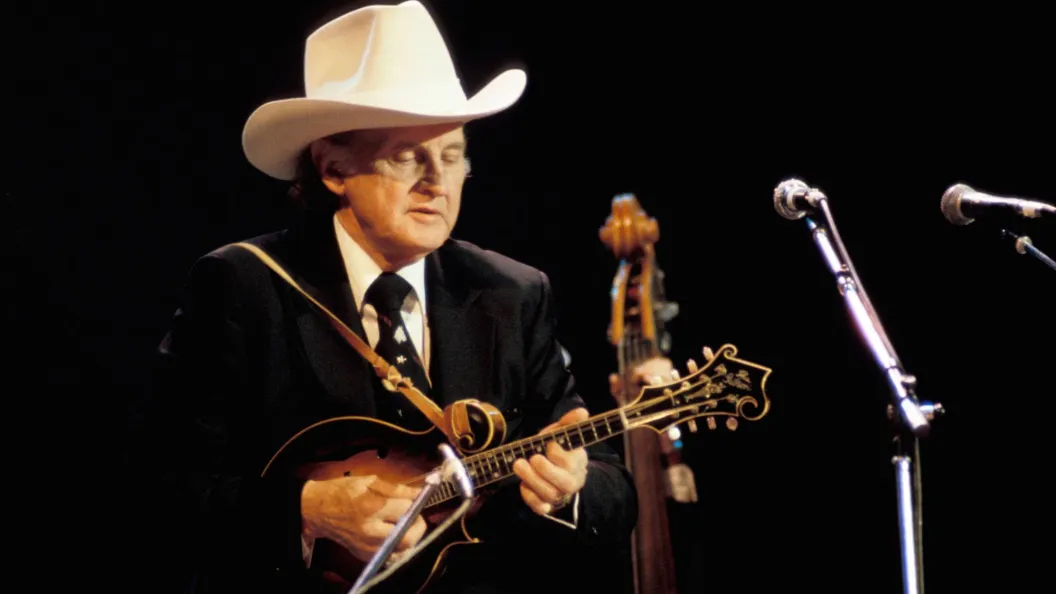
Contemporary bluegrass titan Ricky Skaggs gives credit where it’s due. “I don’t know how I could extract the influence of Bill Monroe’s music from what I play today… He is the one constant that I continue to go back to—it’s the foundation of what I stand on,” Skaggs told The Bluegrass Special in 2011.
Indeed, all modern bluegrass musicians are standing on Monroe’s shoulders. Blending gospel harmonies and Celtic fiddles with blues, jazz, and folk music, the “Father of Bluegrass” elevated the sounds of his rural Kentucky upbringing to an art form.
He is one of just five performers — alongside Jimmie Rodgers, Bob Wills, Hank Williams, and Johnny Cash — to gain entry into the Country Music Hall of Fame, the Nashville Songwriters Hall of Fame, and the Rock and Roll Hall of Fame.
William Smith Monroe was born on this day (September 13) in 1911 on a farm near Rosine, Kentucky. In honor of what would have been his 115th birthday, we’re exploring his remarkable legacy.
How Bill Monroe Overcame Early Tragedies
The youngest of eight children, Bill Monroe grew up immersed in music. His mother, Malissa, passed down dance steps and traditional British-American folk ballads to her children.
Meanwhile, Malissa’s brother, James Pendleton “Uncle Pen” Vandiver, was an old-time fiddler whom Monroe often accompanied on the mandolin at local square dances.
Arnold Shultz, a Black blues guitarist, often played the same events as Monroe and his uncle, and the younger man counted Shultz among his greatest musical influences.
After losing both his parents by age 16, Monroe bounced around other relatives’ homes before eventually settling with Uncle Pen.
In 1929, he followed older brothers Birch and Charlie to Indiana, where the three siblings worked together at a Sinclair Oil refinery.
“I could have had a better education, and I could have had better clothes to wear to school,” Monroe told fellow bluegrass musician Alice Gerrard in 1969, per NPR. “I could have had a better chance, you know. But if I’d had the best education in the world, I might have not played music.”
Inventing Bluegrass
After moving to Indiana, Bill Monroe performed with Birch, Charlie, and family friend Larry Moore as the Monroe Brothers.
They often played local dances and house parties, with Bill on mandolin, Charlie on guitar, and Birch on fiddle.
Eventually, Moore and Birch left the group, but Bill and Charlie carried on as a duo. Getting their start on local radio stations, their influence had spread to the Carolinas by the mid-1930s.
From 1936 to 1938, the Monroe Brothers recorded 60 songs for Victor’s Bluebird label, including the gospel hit “What Would You Give in Exchange For Your Soul?”
The Blue Grass Boys
In 1938, Charlie and Bill Monroe went their separate ways. After a short-lived stint in Little Rock, Arkansas, with a band he dubbed the Kentuckians, Bill moved to Atlanta, Georgia.
That’s where he formed the earliest iteration of the Blue Grass Boys — named for the blue grass of his home state —with singer/guitarist Cleo Davis, fiddler Art Wooten, and bassist Amos Garren.
In 1939, Monroe landed a regular spot on the Grand Ole Opry after impressing founder George D. Hay with his lively rendition of Jimmie Rodgers’ “Mule Skinner Blues”.
He spent the 1940s perfecting the style now universally recognized as bluegrass. Monroe owes much of his signature sound to guitarist Lester Flatt and banjoist Earl Scruggs, who joined the Blue Grass Boys in late 1945.
Before leaving Monroe’s band to form the Foggy Mountain Boys in 1948, Flatt and Scruggs contributed to the timeless bluegrass waltz “Blue Moon of Kentucky” in 1947.
Seven years later, Elvis Presley outdid Monroe with an upbeat, bluesy rendition of the song. Both versions charted across the southern United States, although Presley’s consistently ranked higher.
The Rise and Fall of Bluegrass
Bill Monroe’s immense popularity stretched through the 1950s. However, as the decade neared its end, rock and roll and the countrypolitan “Nashville sound” began to overtake bluegrass.
However, the 1960s ushered in the height of the folk-music revival, which led to a career resurgence for Monroe. In 1967, he founded his own annual music festival in southern Indiana.
[RELATED: 6 Essential Bluegrass Albums for Your Collection]
Bill Monroe played his final show on March 15, 1996. He officially retired from performing the following month after suffering a stroke.
On September 9, 1996, Bill Monroe died in Springfield, Tennessee, just four days shy of his 85th birthday.
Featured image by David Redfern/Redferns
The post Born 115 Years Ago Today in Kentucky, the Singer, Songwriter and Mandolinist Who Single-Handedly Created the Bluegrass Genre appeared first on American Songwriter.
Go To Source | Author: Erinn Callahan
« Every Baby Boomer Alive Remembers These 4 Must-Hear Soft Rock Hits From 1978
Remember When The Rolling Stones Fired the Band’s Founder in 1969? »