


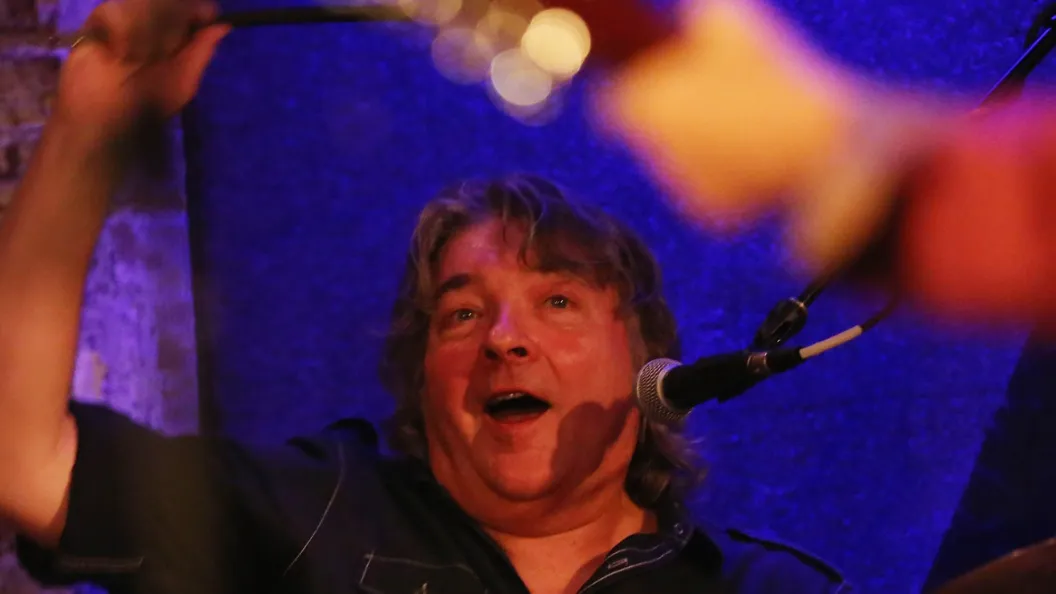
On this day (August 24) in 1953, Steve Holley was born in London, England. Over the years, he has worked with a long list of legendary musicians. Holley has recorded with Chuck Berry, Julian Lennon, Kiki Dee, Joe Cocker, Tommy Shaw, and many others. In the 1970s, Elton John offered him a place in his backing band. However, he chose to join Wings and work with Paul McCartney.
Holley was born into a musical family. His father led a swing band, and his mother was their singer. Their next-door neighbor was the band’s drummer. Later, that neighbor helped the young Holley learn the basics. By the time he was 11 years old, he had formed his first band, which won a local talent competition.
According to an interview with drum manufacturer Pearl, Holley initially planned to attend the Royal College of Music to study guitar, piano, and drums. However, he chose to quit school and pursue his career. After relocating to Holland, he joined G.T. Moore and the Reggae Guitars and recorded an album in 1975. Soon, he formed another group called Vapour Trails. They were, as he put it, “…a band who could work as session guys behind anybody.”
Steve Holley Makes a Tough Choice
In the late 1970s, the Vapour Trails were backing Kiki Dee when she began working on her 1977 self-titled album for Rocket Records. Elton John was producing the record. At the same time, he was rebuilding his band and working on his album A Single Man. He invited Holley to play on the single “Ego,” which led to him playing drums on the rest of the album. Afterward, John invited Holley to join his band permanently.
Around this time, Wings co-founder Denny Laine moved to Holley’s hometown. They became friends and, one evening, Laine invited Holley to a party at his house. The rest of the band, including Paul McCartney, was there. People were jamming in a large music room, but the drums were unoccupied. “I thought that was my opportunity,” Holley recalled. “I remember Denny’s jaw dropping because I don’t think he really knew that I could play. He thought it was a hobby or something,” he added.
Soon, McCartney called Holley and asked him to come to London for an audition.
“It was a difficult decision. Elton was huge at that time. He was probably the biggest act there was, at that point. He was such a nice guy, and he made me feel so welcome, so comfortable,” Holley recalled. “I think that enabled me to work with McCartney. Elton helped me get over the nervousness. Just meeting Paul was terrifying.”
Eventually, Steve Holley chose to join Wings. “I would have loved to stay with Elton, but I had made the record, and how many times in my life am I going to get the opportunity to work with McCartney?” he said. He was with Wings for three years and played on Back to the Egg, among other recordings.
Holley After Wings
In the 1980s, Steve Holley moved to the United States, which opened up several more opportunities for him. He played on Julian Lennon’s debut album, backed B.B. King, Stevie Wonder, Macy Gray, Wyclef Jean, Sheryl Crow, and others at a White House benefit, and has recorded solo albums. However, historically speaking, none of those measure up to the time he played during the fall of the Berlin Wall.
He spent three years as Joe Cocker’s drummer. During that time, Cocker was among the acts who were chosen to play as the Berlin Wall came down. “We were invited to play a concert for the first 10,000 people arriving from the DDR (East Germany), but by the time we took the stage, there were thousands more inside and outside of the stadium,” he told The Long Island Pulse. “When we began to play the last song, ‘With a Little Help from My Friends,’ a roar from the crowd threatened to raise the roof,” he recalled.
Featured Image by Al Pereira/Getty Images
The post Born 73 Years Ago in London, the Drummer Who Played With Joe Cocker as the Berlin Wall Fell and Had to Choose Between Elton John and Paul McCartney appeared first on American Songwriter.
Go To Source | Author: Clayton Edwards
« Jamey Johnson On Toby Keith’s Legendary Golf Course Trash Talk
4 Incredible Albums From Veteran Rock Acts Who Withstood the Grunge Onslaught in 1991 »