


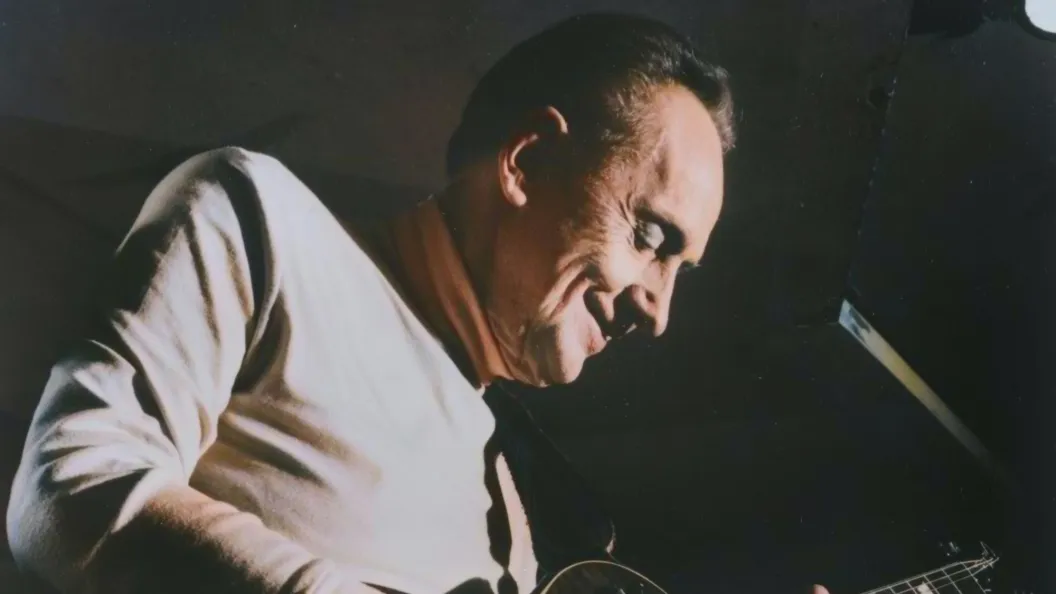
Jimmy Page, George Harrison, Guns N’ Roses’ Slash—some of rock and roll’s biggest names have wielded the iconic Les Paul guitar onstage. Indeed, it’s impossible to imagine “Paradise City” or “Black Dog” without the unique solid-body electric guitar. Today, we’re exploring the life of the man behind the instrument, who died of complications from severe pneumonia on this day (August 12) in 2009 at White Plains Hospital in White Plains, New York. He was 94 years old, and his enormous influence on popular music will likely linger for at least that long.
Who Was Les Paul?
Born Lester William Polsfuss on June 9, 1915, in Waukesha, Wisconsin, Les Paul wasn’t exactly blessed with preternatural musical talent. In fact, his childhood piano teacher wrote to his mother, “Your boy, Lester, will never learn music.”
However, those words didn’t dissuade him from learning harmonica, piano, guitar, and banjo as a child. And in an early example of his innovative spirit, a 10-year-old Paul invented a harmonica holder from a coat hanger.
He also fashioned his first amplified guitar by opening the back of a Sears acoustic model and inserting the pickup from a dismantled Victrola behind the strings. Later, he would construct his own pickup from ham radio earphone parts, assembling a recording machine using a Cadillac flywheel and the belt from a dentist’s drill.
His Music Career
At 14, Les Paul landed a summer gig with Rube Tronson and his Texas Cowboys, where he first met his mentor and guitar tutor, “Sunny Joe” Wolverton.
Three years later, he dropped out of high school to hit the road with Wolverton as “Sunny Joe” and “Rhubarb Red”.
Together, they made the rounds on “hillbilly” radio stations in Springfield and St. Louis, Missouri, eventually moving on to Chicago and the World Fair.
By the early 1930s, however, Paul was looking for a change. So he made the shift from country to jazz and blues music, forming the Les Paul Trio with Ernie Newton and Jimmie Atkins in 1934.
Three years later, he gained nationwide exposure after securing a featured spot on Fred Waring’s radio show. Unfortunately, a near-fatal electric shock in his New York apartment ended that gig. So Paul returned to Chicago, serving as music director for radio stations WJJD and WIND.
In 1943, he moved to Hollywood, where he filled in for Nat King Cole’s guitarist at the following year’s inaugural Jazz at the Philharmonic concert.
Around that time, the U.S. Army drafted Paul into its ranks. He backed artists like Bing Crosby and the Andrews Sisters while serving in the Armed Forces Radio Network.
Following his discharge, Paul joined NBC Radio as a staff musician in Los Angeles. After he accompanied Crosby on the record-breaking post-war hit “It’s Been a Long, Long Time”, the White Christmas star urged Paul to build his own studio.
Additionally, Paul recorded with his second wife, Mary Ford, in the early 1950s. Their hits included “Tennessee Waltz”, “Mockingbird Hill,” “How High the Moon” and “The World Is Waiting for the Sunrise”.
These records showcased still more of Paul’s inventive streak, as he experimented with overdubbing, multitrack recording and new electronic effects.
Changing the Game
Les Paul’s brilliant musical innovations were born of necessity rather than a desire for the spotlight.
“Honestly, I never strove to be an Edison,” he told The New York Times in 1991. “The only reason I invented these things was because I didn’t have them and neither did anyone else. I had no choice, really.”
Following Paul’s death, Terry Stewart—then president and CEO of the Rock and Roll Hall of Fame and Museum—shared effusive praise for the musical icon.
[RELATED: Did You Know He Invented Overdubbing? 5 Fascinating Facts About Les Paul]
“Without Les Paul, we would not have rock and roll as we know it,” Stewart said. “His inventions created the infrastructure for the music and his playing style will ripple through generations. He was truly an architect of rock and roll.”
Featured image by Heritage Art/Heritage Images via Getty Images
The post 17 Years Ago Today, We Said Goodbye to the “Wizard of Waukesha” Whose Guitar Innovations Paved the Way for Rock and Roll appeared first on American Songwriter.
Author: Erinn Callahan
« 3 Love Songs From the 70s That Were Real-Life Apologies
Breakout Country-Pop Star Behind One of 2026’s Biggest Hits Is Headed to the Grand Ole Opry »