


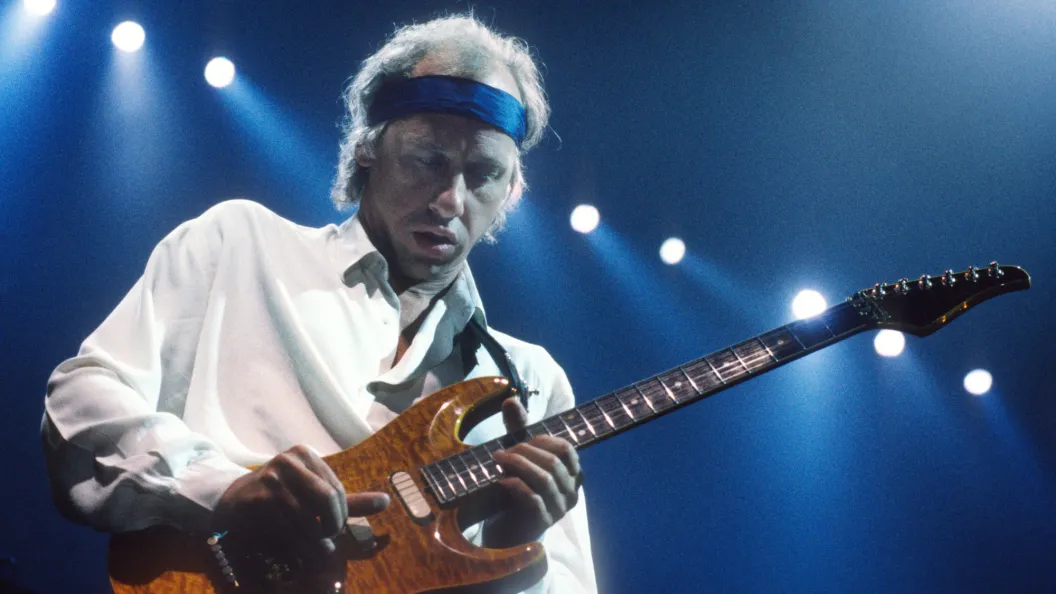
Dire Straits: Mark Knopfler
Photo gie Knaeps
Popular musicians generally realize that their time in the white-hot glow of the spotlight, if they’re lucky enough to make it that far, is going to be limited. That’s why the general theory is that it’s best to strike while the iron is hot.
Mark Knopfler did not follow that maxim after Dire Straits enjoyed the biggest commercial success of its career. Instead, the band waited around for six years before releasing a farewell album that nobody even realized was a farewell.
Sudden Stars
When Dire Straits emerged with their debut single “Sultans Of Swing” in 1978, they had the feel of a scrappy underdog. They weren’t flashy in any way and didn’t have any special hook that set them apart. Their style of music was a far cry from the New Wave and punk dominating the era.
But they boasted a songwriter and guitarist who could stand tall with anybody in those departments. Mark Knopfler led the band through a series of critically acclaimed albums in the late 70s and early 80s that never quite did well enough to make the band superstars.
With the 1985 song “Money For Nothing”, which went to No. 1 on the US pop charts, the band reached the rock elite. Suddenly, Dire Straits was big business. After an elongated tour to support the album Brothers In Arms, which included “Money For Nothing”, the world waited for their follow-up. And waited. And waited some more.
‘Street’ of Dreams
As it turned out, the experience of Brothers In Arms and its phenomenal success didn’t sit all that well with Knopfler. While he loved music, he didn’t love the machinery of rock stardom. He essentially shuttered the band at the end of the aforementioned tour, focusing for a while on soundtrack scores and side projects.
The 80s turned into the 90s, and there was still no sign of Dire Straits. Then, all at once, Knopfler decided to reconvene the group for another album. Recording began in late 1990 for the album that would be known as On Every Street upon its release in September 1991.
By that time, Dire Straits was a quartet, with only bassist John Illsley remaining with Knopfler from the earliest days of the band. Many guest musicians appeared to help fill out the tracks. But, as usual, Knopfler’s singing, writing, and guitar work were at the forefront.
An Unspoken Farewell
On Every Street is very much split down the middle. About half the record is given over to playful, often sarcastic rockers like “Calling Elvis”, “The Bug”, and “Heavy Fuel”. The rest of the record goes for a jazzy, after-hours vibe. Songs like the title track, “Fade To Black”, and “Iron Hand” are penetrating works that stray far from the modern rock scene at the time.
Maybe it was Knopfler’s way of letting everyone know that he was already planning his next move. Dire Straits dutifully toured behind On Every Street, which sold very well even without the benefit of a big hit single. At the end of the tour, no announcement was made about the band’s future.
Maybe that’s because there was no future to discuss. Dire Straits never again reconvened, as Mark Knopfler moved on to his solo career. As such, On Every Street turned out to be the band’s unassuming swan song.
(Photo by Gie Knaeps/Getty Images)
The post Remember When Dire Straits’ Long-Awaited Comeback Also Turned Out To Be Their Farewell in 1991? appeared first on American Songwriter.
Author: Jim Beviglia
3 One-Hit Wonders From 1971 That 70s Kids Will Never Forget »