


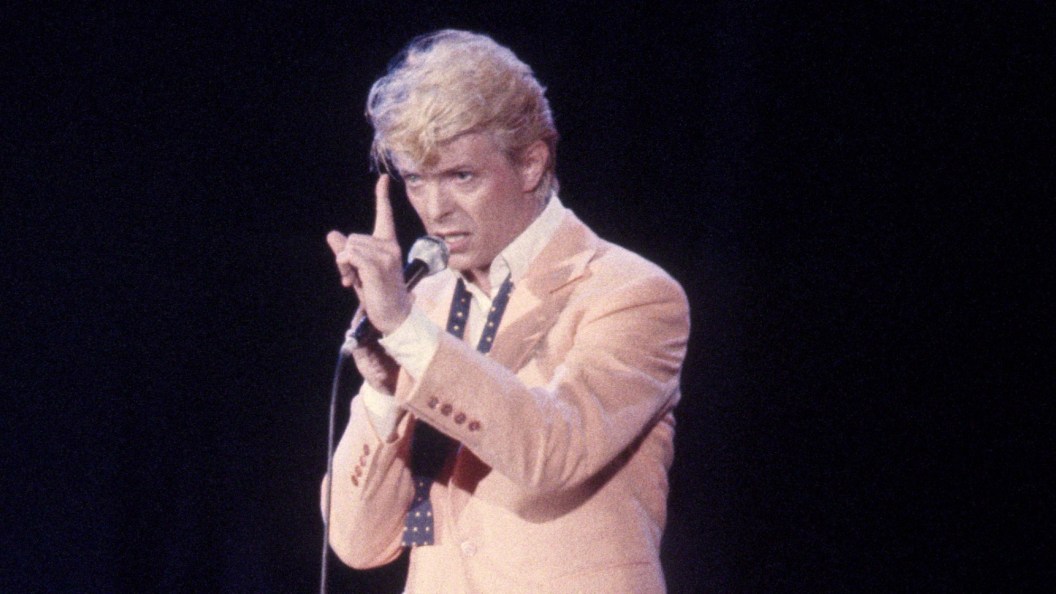
Throughout his amazing career, David Bowie released a series of unforgettable albums. Alas, Tonight, released in 1984, is one of those that can easily slip from memory. Bowie himself later regretted how the record was made.
Yet amidst that, Bowie still emerged with the peppy rocker “Blue Jean”. The song continued his hot streak at the time and became one of his most often-played hits.
Keep Dancing
More than he ever had before, David Bowie went all-in for pop stardom on his 1983 album Let’s Dance. And he nailed it. The album and several of its singles leavened his innate tendencies to the experimental and the strange just enough to become a mainstream smash. The Serious Moonlight tour that followed only cemented his success in that regard.
When he came off the road, EMI Records, Bowie’s longtime label, wanted him to capitalize on his newfound success by getting back in the studio as soon as possible. Bowie obliged, even though he didn’t really have much in the way of new material that he could record.
As a result, Tonight became an odd hybrid of a record. He covered a couple of 60s chestnuts, rehashed several songs originally recorded by his old buddy Iggy Pop, and wrote a few new tunes with Pop. Bowie only wrote two songs on the record by himself, one of which was “Blue Jean”, the first single.
Blue on “Blue”
Bowie explained to New Musical Express (per TheBowieBible) at the time that “Blue Jean” originated from multiple influences, including some rockabilly and garage rock icons:
“’Blue Jean’ reminds me of Eddie Cochran. It was inspired from that Eddie Cochran feeling, but that of course is very Troggs as well. I dunno… it’s quite eclectic, I suppose. What of mine isn’t?”
Bowie released “Blue Jean” complete with a short video film that ran over 20 minutes, while an edited version often played on MTV. The song roared to the Top 10 in 1984, the last time that he’d ever reach that high on the American charts.
In later years, Bowie expressed dismay with the way that Tonight was recorded. He expressed even more distaste for its follow-up, Never Let Me Down. His frustration with the two records eventually led to the formation of his short-lived band Tin Machine.
Behind the Lyrics to “Blue Jean”
Even though the lyrics for “Blue Jean” are somewhat simplified, there are still enough quirks in there for it to fit with the rest of Bowie’s catalog. “She got a camouflaged face and no money,” he explains of his unlikely paramour. But he suggests that others he’s courted haven’t sufficed: “Remember, they always let you down when you need ‘em.”
What does “Blue Jean” have that other potential girlfriends lack? Well, a “police bike,” a “turned-up nose,” and “Latin roots.” He wants to wow her with his poetic words, but he’s not quite there yet: “One day, I’m gonna get that faculty together.” Anyway, he feels at ease with his choice: “Oh, Blue Jean, look out, world, oh, you know, I’ve got mine.”
What the words don’t convey, the music, full of crunching guitars, greasy saxophones, and slinky marimba, communicates just fine. The album containing it might have faltered. But “Blue Jean”, as a standalone, represents Bowie at a refreshingly accessible high point.
(Photo by PL Gould/IMAGES/Getty Images)
The post One of David Bowie’s Most Beloved 80s Hits Came From an Album He Wanted To Forget appeared first on American Songwriter.
Author: Jim Beviglia
Ella Langley Adds 7 New RIAA Certifications as Her Record-Breaking 2026 Rolls On »