


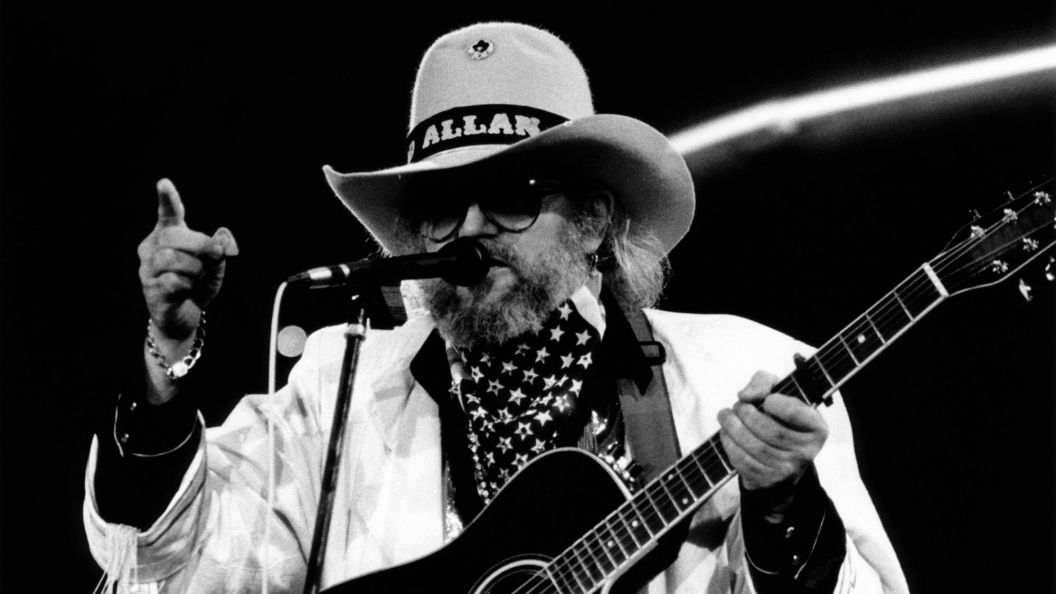
For David Allan Coe, authenticity was a double-edged sword. His rebellious streak and outlandish antics lent credence to the outlaw country songs he wrote, earning him a dedicated fan base. At the same time, however, those very antics were his biggest barrier to mainstream success. Regardless, he certainly did things on his own terms right up until his death in April 2026 at age 86. His most enduring legacy is found in the songs he wrote for other artists, including Johnny Paycheck’s chart-topping 1977 classic “Take This Job and Shove It” and the number-one Tanya Tucker hit “Would You Lay with Me (In a Field of Stone)”.
In honor of what would have been his 87th birthday, we’re exploring the complicated, often contradictory life and career of country music’s “Mysterious Rhinestone Cowboy,” David Allan Coe — born in Akron, Ohio, on this day (September 6) in 1939.
David Allan Coe Began His Songwriting Career Behind Bars
From a young age, authorities simply didn’t know what to do with David Allan Coe. First sent to a boys’ reform school at age nine, he spent the next two decades cycling in and out of juvenile and adult correctional facilities.
Coe built a lengthy rap sheet, with his convictions ranging from possession of burglary tools to auto theft.
The way the singer-songwriter tells it, his passion for songwriting was born behind those bars. During his time at the Ohio Penitentiary in Columbus, he first picked up a pen at the encouragement of a fellow inmate.
That inmate was early shock-rock pioneer “Screamin’” Jay Hawkins — of “I Put a Spell On You” fame.
Singin’ the Post-Lockup Blues
Determined to make a name for himself in music, David Allan Coe headed to Nashville upon his 1967 release from prison.
At first, he lived in his car, often camping out in front of the Ryman Auditorium and busking on street corners to make ends meet.
Three years later, Coe released his debut album, Penitentiary Blues, in 1970. An AllMusic review descibed the singer’s freshman effort as “a rowdy, funky, and crude blues record.”
Coe’s particular brand of blues-country resonated, leading to a tour with Grand Funk Railroad and a contract with Columbia Records.
In 1975, he scored one of his definitive hits with “You Never Even Call Me By My Name” — co-written by John Prine.
More hits followed in the next decade, including “The Ride” (1983, and “Mona Lisa Lost Her Smile” (1984).
However, by the dawn of the 1980s, the outlaw-country craze was giving way to something slicker and more polished.
Refusing to compromise, Coe instead doubled down on his particular brand of vulgarity. Still, he managed chart success with his 1983 album Castles in the Sand, which peaked at number eight on the country albums chart.
A Contentious Figure
David Allan Coe was a divisive figure even among his outlaw peers. As Waylon Jennings put it, “he could drive me crazy, but there was something about David that pulled at my heartstrings.”
Amid allegations of in his lyrics and legal conflicts with the Internal Revenue Service, Coe reached across genre lines in the early 2000s. He collaborated with artists like Kid Rock and Pantera guitarist “Dimebag” Darrell Abbott.
On April 29, 2026, David Allan Coe died of pneumonia at a hospital in Daytona Beach, Florida. He was 86 years old.
The singer-songwriter’s wife, Kimberly Coe, paid tribute to him in a statement to Rolling Stone.
[RELATED: Final Album From David Allan Coe Set for Posthumous Release]
“One of the best singers, songwriters, and performers of our time [and] never to be forgotten,” she wrote. “My husband, my friend, my confidant and my life for many years. I’ll never forget him and I don’t want anyone else to ever forget him either.”
Featured image by David Redfern/Redferns
The post Born 87 Years Ago Today in Ohio, the “Mysterious Rhinestone Cowboy” Who Embodied Outlaw Country and Penned This Johnny Paycheck Smash appeared first on American Songwriter.
Author: Erinn Callahan
« 3 Rock Songs From the 1980s That Mean More When You Listen to Them With Friends