


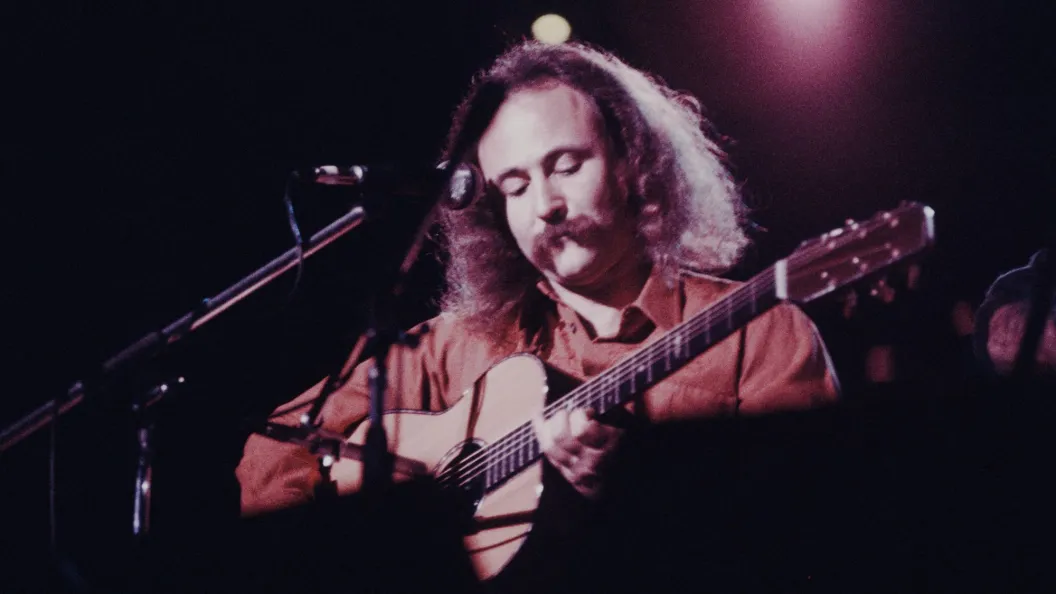
Crosby, Stills & Nash had the music world by the tail at the start of the 70s. Their first two albums, the second of which featured Neil Young, positioned them as the rare supergroup whose output eclipsed the sum of their parts. They then used 1971 as an opportunity to stake out their turf as solo artists. Instead of going for the pop music brass ring, which was likely within his reach if he wished, David Crosby went weird and wild on his own solo effort that year.
Solo Croz
After leaving The Byrds, David Crosby acted as the fulcrum for the creation of Crosby, Stills & Nash. He had standing relationships with the two other men before the formation of the group. When Neil Young joined for the making of the Déjà Vu album, the public’s fascination with this assemblage grew.
But during the making of that album, Crosby experienced a devastating tragedy. A car accident claimed the life of his girlfriend Christine Hinton in 1969. After touring with CSNY throughout 1969 and 1970, Crosby, like the other members of the group, had the time to explore his own musical options.
Considering that relations between the band members were extremely strained by that time, it’s surprising that Crosby enlisted the help of the other three members for the record that would be titled If I Could Only Remember My Name. Then again, Crosby reached out for help to some of the biggest musicians on the planet for the record, a collaborative effort fueled by his mercurial vision.
All-Star Cast
Crosby recorded the bulk of the album at Wally Heider Studios in San Francisco. At the time he made the record, both Jefferson Airplane and The Grateful Dead were nearby and often popped in for Crosby’s sessions. In particular, Jerry Garcia was a constant presence throughout the making of the record.
The vocal blend was pristine as well. As mentioned, Stills, Nash, and Young chipped in on certain tracks, while Joni Mitchell and Grace Slick came along for the ride as well. On any given track, you’d find an assortment of all-stars pitching in to help bring Crosby’s artistic vision to life. And the company he was keeping also proved therapeutic as he dealt with his sorrow over the loss of Hilton.
It was by no means a commercially viable vision. A few of the songs on If I Could Remember My Name feature no lyrics, just wordless refrains of multi-tracked vocals. Even the songs that had words refused easy categorization, with the mournful “Laughing” the closest thing to a radio-ready track out of the nine on the album.
An Album to ‘Remember’
At the time it was released, fans and critics alike scratched their collective heads at If I Could Only Remember My Name. The other solo albums by the CSNY members bore a strong resemblance to the group’s work. By contrast, Crosby wandered down his own impenetrable path.
Nonetheless, If I Could Only Remember My Name built a devoted following over the years. Many folk musicians with a bit of an independent streak found inspiration in its nomadic melodies and atmospheric harmonies.
David Crosby wouldn’t release another solo album for 18 years. Some consider If I Could Only Remember My Name an all-star flop. Others (and we’re in this camp) find in it an idiosyncratic yet moving evocation of grief. No matter where you stand, there’s no doubting the Croz’s fearlessness in releasing a grower like that at such a pivotal time in his career.
(Photo by Koh Hasebe/Shinko Music/Getty Images)
The post Remember When David Crosby Released a Spacey Solo Album in 1971? appeared first on American Songwriter.
Author: Jim Beviglia
« On This Day in 1975, Glen Campbell Was at No. 1 With a Song He Discovered While on Tour in Australia