


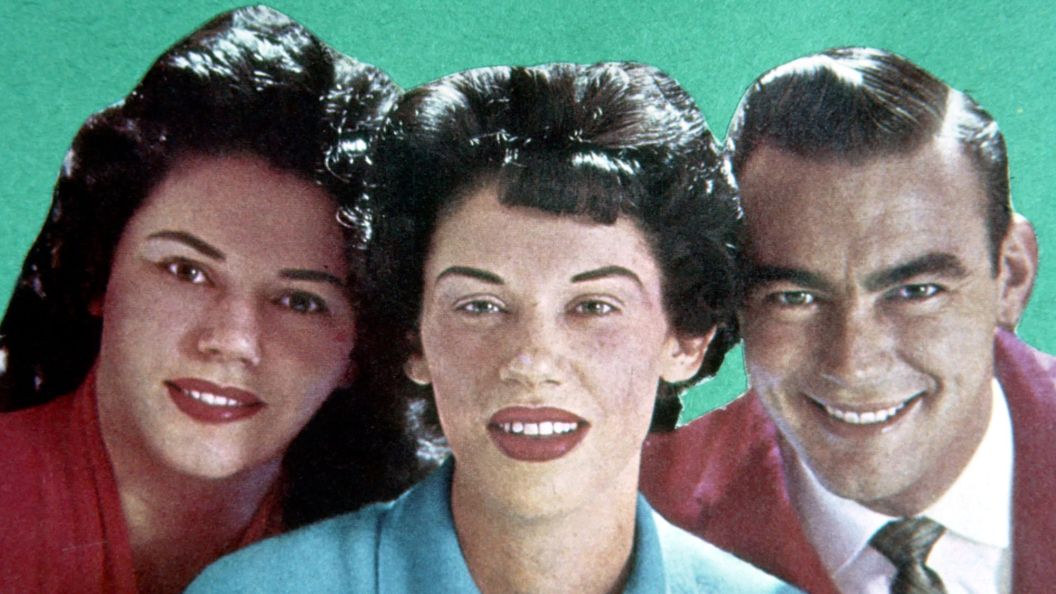
Before Jim Ed Brown earned recognition for solo songs like “Pop a Top” and “Southern Living”, he rose to fame in the early 1950s in a family trio with his sisters, Maxine and Bonnie Brown. Hailed among the most important vocal acts of the Nashville Sound era, the Browns beautifully harmonized on songs like their 1959 Grammy-nominated hit “The Three Bells”.
Unlike her older siblings, Bonnie Brown did not pursue a solo career after the trio went their separate ways in 1968. Instead, she chose to settle back home with her husband and raise their daughters. Still, she is a vital part of the Browns’ legacy that brought country music to a wider audience in the 1950s and ’60s. Today, we’re diving into the life and career of Bonnie Jean Brown, born in Sparkman, Arkansas, on this day (July 31) in 1938.
Bonnie Brown Didn’t Join Her Siblings Onstage Right Away
Bonnie was the youngest of three children born to Floyd Iron Brown and Birdie Lee Tuberville Brown.
When she was young, the family moved to Pine Bluff, Arkansas, where Maxine and Jim Ed first began performing as a duo. Landing a spot on the popular Shreveport Louisiana Hayride radio program, they signed with Faber Robison of Fabor Records.
In 1954, the duo recorded their first top 10 hit, “Looking Back to See”. Unfortunately, their contract with Robinson blocked them from collecting any royalties.
The following year, 18-year-old Bonnie joined her siblings on the road. She sang soprano, with Jim Ed on baritone and Maxine on alto.
After scoring another top 10 country hit, “Here Today and Gone Tomorrow”, the Browns trio signed with RCA Records in 1956. Two more top five hits followed with “I Take the Chance” and “I Heard the Bluebirds Sing.”
Breaking Through With the Browns
By 1959, the siblings were contemplating retirement. Jim Ed served in the military and ran their father’s sawmill, while Maxine and Bonnie Brown each married and started families.
However, any thoughts of quitting the business disappeared following the massive success of the Browns’ 1959 folk-pop hit “The Three Bells”.
Adapted from the French-language song “Les Trois Cloches”, the single soared to the top of both the country and pop charts, holding each spot for multiple weeks.
Selling more than a million copies, “The Three Bells” also scored nominations for Record of the Year and Best Group or Vocal Performance at that year’s Grammy Awards.
Thanks to “The Three Bells” and other crossover hits “Scarlet Ribbons (for Her Hair)” and “The Old Lamplighter,” the Browns made the rounds on network TV, toured overseas, and officially joined the Grand Ole Opry in 1963.
Going Their Separate Ways
In 1967, Bonnie Brown left the trio after 12 years, returning to Arkansas to raise her family.
“I didn’t want to leave my children, and I just felt like I was holding Jim Ed and Maxine back,” she said in a 2015 interview. “It was a hard decision to make, but I’m glad I made it.”
Unlike her siblings, Bonnie did not pursue a solo career, although she did reunite with Jim Ed and Maxine for occasional performances in the 1980s.
In 1986, the Browns recorded a new album titled Jim Ed Brown & The Browns, which failed to chart. Ten years later, they recorded a new collection of gospel songs titled Family Bible in 1996.
The group were inducted into the Country Music Hall of Fame in 2015. On June 11, 2015, Jim Ed Brown died from lung cancer at age 81.
A little over a year later, Bonnie Brown also died from lung cancer at age 77 on July 16, 2016, at Baptist Health Medical Center in Little Rock, Arkansas.
Dr. Gene “Brownie” Ring, her husband of more than 56 years, had died six months earlier in January.
Bonnie Brown Ring was survived by their daughters Kelly and Robin, by several grandchildren and by her sister Maxine, who died on on January 21, 2019, at the age of 87 from complications of heart and kidney disease.
Featured image by Michael Ochs Archives/Getty Images
The post Born 98 Years Ago Today in Arkansas, the Youngest Member of This Country Music Hall of Fame Sibling Trio appeared first on American Songwriter.
Author: Erinn Callahan
« 3 Songs That Are So Iconic You Might Have Forgotten the Bands Who Sing Them
Morgan Wallen Surprises North Las Vegas High School With Nearly $40,000 Donation »