


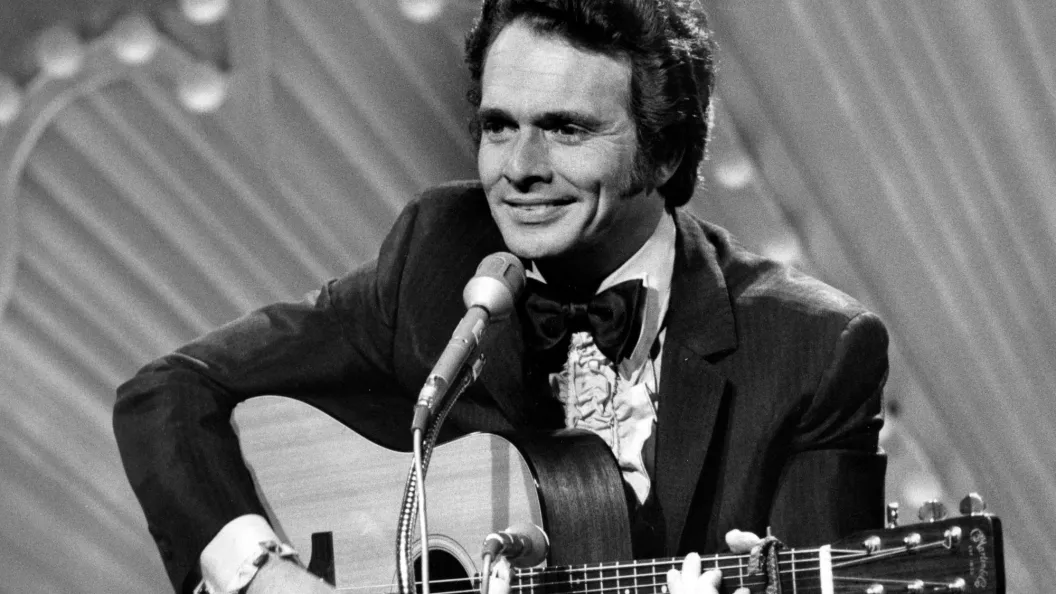
Merle Haggard’s disagreement with the general public over artistic matters was a familiar theme for the country star throughout most of his career. He was well accustomed to people taking his songs the wrong way, like in “Okie From Muskogee”. Or record labels ignoring songs he felt the most passionate about, like “Irma Jackson”. And when it came to the most cathartic and satisfying song he ever wrote, “Huntsville”, he once again didn’t see eye to eye with the public.
Speaking to Uncut in 2010, Haggard reflected on how songwriting had become therapeutic for him without him even realizing it. “I’ve never really talked about it, but it is a sort of therapy. And it actually works. You can shout about what you hate, and someone will listen. It’s kind of like throwing a tantrum or something.”
Haggard pointed out “Huntsville” from Someday We’ll Look Back, co-written with Red Simpson, as being one of his most cathartic. “I remember having that feeling of release from the writing of that song. It didn’t get a lot of play. But it did that thing for me.”
Merle Haggard’s Most Cathartic Song, “Huntsville”, Stayed a Deep Cut
Merle Haggard was right—the 10th track on Someday We’ll Look Back got minimal play compared to other songs on the album. The title track was a No. 2 hit, while “Carolyn” topped the Billboard Hot Country Songs chart. “Huntsville”, meanwhile, got lost in the shadows. But it’s easy to see why Haggard felt so strongly about that song in particular.
In typical Haggard fashion, “Huntsville” is a defiant prison song. The narrator sings about a “white-haired judge in Dallas” sending him to prison in Huntsville. Throughout the song, the narrator talks about how he has plans to escape prison one way or another, whether that’s finding an escape route to Mexico or being gunned down on his way out. “I’ve got two long life turns to do / both running and don’t end.”
The third verse makes the song sound autobiographical. “My hands don’t fit no chopping pole / and cotton never was my bag / the man better keep both eyes on me / or they’re going to lose old Hag.” However, Haggard never did time in Huntsville, only San Quentin State Prison in California.
Moreover, Haggard never tried to escape his maximum-security prison. (Though we should note the reason he was in a maximum-security prison was because of the many attempts he made to break out of jail.)
The one time he had an opportunity to escape San Quentin, one of the conspirators, James “Rabbit” Kendrick, told him not to do it, telling Haggard he was too talented to risk getting caught. Kendrick ran, killing a peace officer in the process, and was later caught, returned to prison, and executed.
Photo by ABC Photo Archives/Disney General Entertainment Content via Getty Images
The post Merle Haggard Said This 1971 Deep Cut Was the Most Cathartic To Write, Despite It Being Unpopular appeared first on American Songwriter.
Go To Source | Author: Melanie Davis
« 3 Songs From the Late 70s That Helped Usher in 80s Rock
3 Country Voices From the 1970s You’ll Recognize in About Two Seconds »