


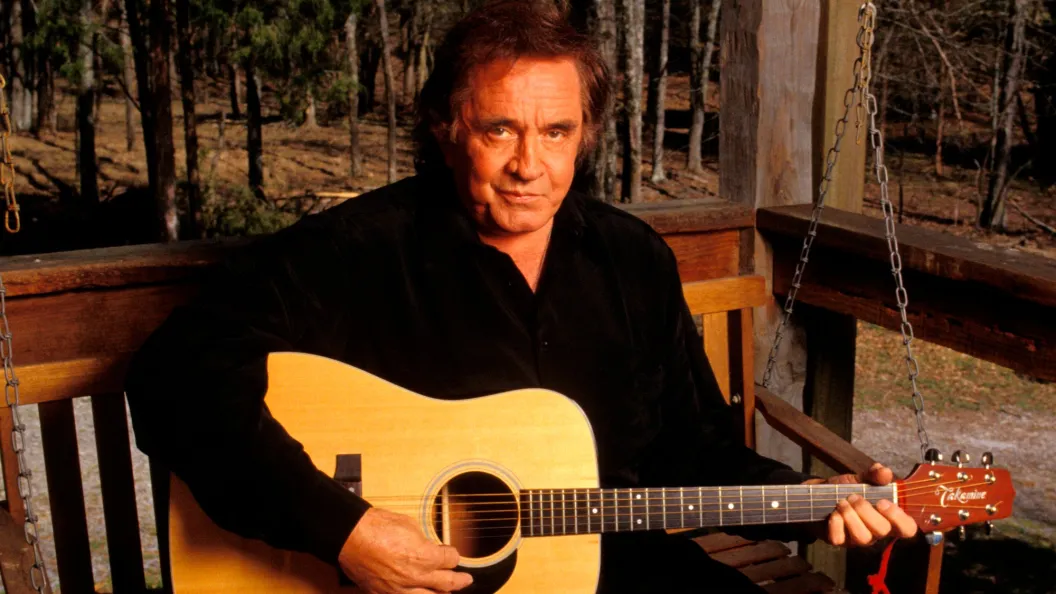
On this day (July 22) in 2006, Johnny Cash topped the Billboard 200 with American V: A Hundred Highways. His last album to top the all-genre chart was At San Quentin, which held the top spot for four weeks in 1969. This was also his first solo LP to top the country chart in more than three decades. Man in Black was his last chart-topping album. It held the top spot for two weeks in 1971. Unfortunately, Cash wasn’t alive to see the LP’s success.
Cash was as close to being “washed up” as a genre icon can get in the early 1990s. His last hit album, One Piece at a Time, peaked at No. 2 on the country chart in 1976. His last hit single, “The Baron,” reached No. 10 in 1981. By 1993, he was playing dinner theaters and holding residencies in Branson, Missouri. At the same time, he was in the middle of a drawn-out dispute with his label, Polygram.
Most who were still paying attention, Cash included, assumed his career was on its last legs. While he still had fans around the world, the industry had seemingly moved on. Then, Rick Rubin reached out to his manager, Lou Robin, and asked to set up a meeting with the Man in Black.
Johnny Cash Meets Rick Rubin
On February 27, 1993, Johnny Cash played at the Rhythm Cafe in Santa Ana, California. He met Rick Rubin backstage after the show. After introductions, they stared at each other for a couple of minutes before Cash laid his cards on the table. “What’re you gonna do with me that nobody else has done to sell records for me?” he asked Rubin.
Rubin didn’t have a grand plan. “I don’t know that we will sell records. I would like you to sit in my living room with a guitar and two microphones and sing to your heart’s content, everything you ever wanted to record.” That was good enough for Cash. Later that year, he inked a deal with American Recordings.
“The thing that intrigued me was that the man that produced the rap music and the Chili Peppers and Slayer and all of them was interested in me, personally,” Cash said, reflecting on his partnership with Rubin. “It’s given me an opportunity to express myself artistically that I never had before. I dug out every old song that I ever wanted to sing, and I’ve sung them. It has given me enthusiasm and a new look at what my possibilities and capabilities are that I never thought I would get to experience.”
The American Recordings Albums
Johnny Cash released American Recordings in 1994. While it didn’t do well on the charts, it was widely praised by fans and critics alike. Moreover, it won Best Contemporary Folk Album at the Grammy Awards.
The next installment in the series, Unchained, teamed Cash with Tom Petty and the Heartbreakers. It won the Grammy Award for Best Country Album. Then, in 2000, he released American III: Solitary Man. It was the highest-charting installment at the time, peaking at No. 11 on the country chart and No. 88 on the Billboard 200.
American IV: The Man Comes Around, from 2002, was the final album released before Johnny Cash’s death. It contained his cover of “Hurt,” which won Single of the Year and Music Video of the Year at the CMA Awards, where the LP took Album of the Year. The track “Give My Love to a Rose” won the Grammy for Best Male Country Vocal Performance
[RELATED: The Night Johnny Cash Realized His Old Sound Was Over].
Finally, the series closed with American V: A Hundred Highways. It saw major chart success and the video for “God’s Gonna Cut You Down” won Best Short Form Video at the Grammys.
At the end of the day, though, the success of the albums isn’t what makes them special. They gave fans a look at Johnny Cash in his final days. More importantly, they were his way of sharing music that moved him. As a result, one can come away from these albums knowing a little more about the Man in Black.
Featured Image by Beth Gwinn/Redferns
The post On This Day in 2006, Johnny Cash Was at No. 1 for the First Time in Decades With a Rick Rubin-Produced Masterpiece appeared first on American Songwriter.
Author: Clayton Edwards
« John Fogerty’s Deep Sadness Inspired One of Creedence Clearwater Revival’s Biggest Hits From the 70s
McDonald’s McValue Pack Made For Sneaking Food Into Stadiums »